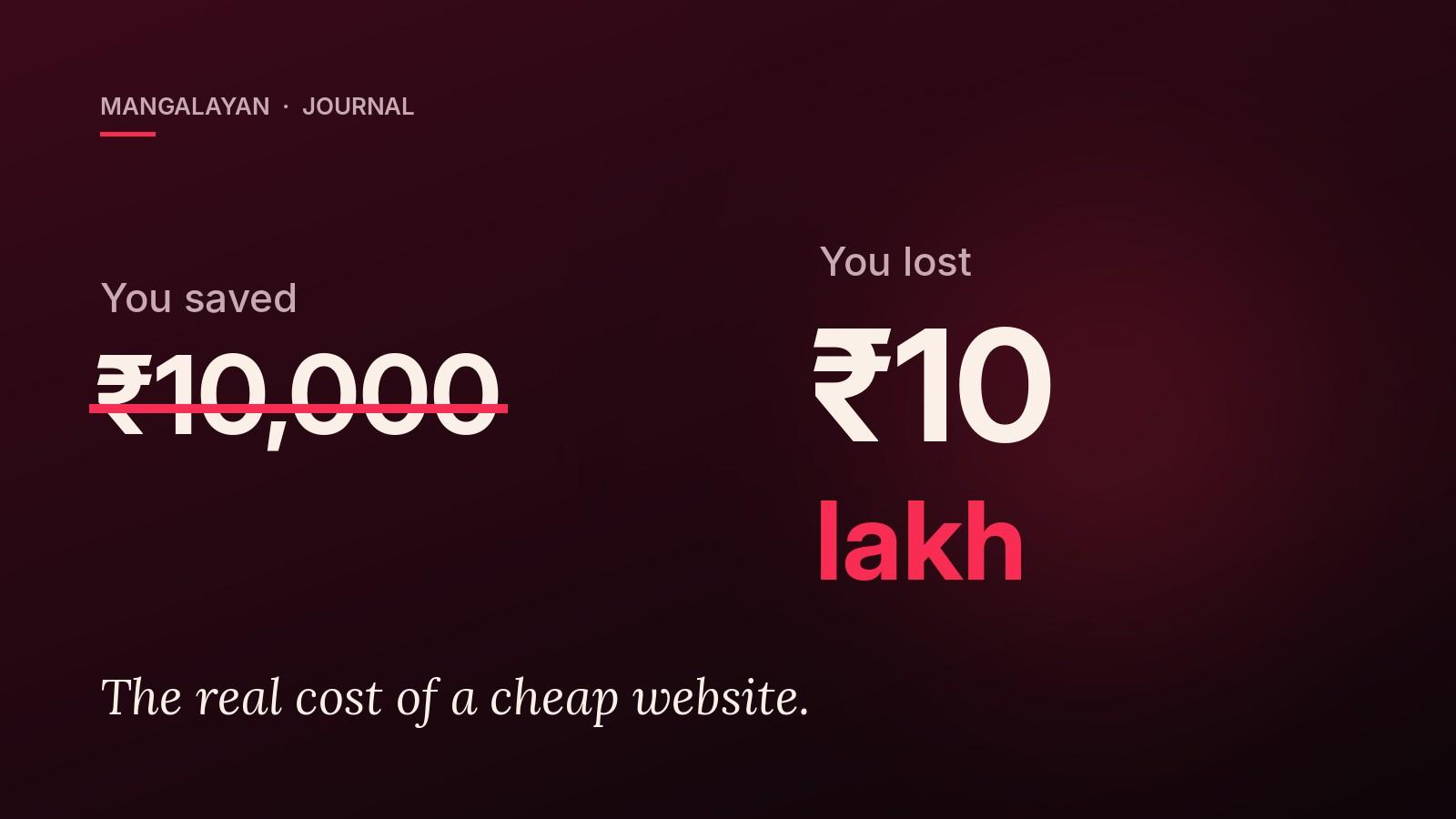
Your ₹10,000 Website Is Costing You ₹10 Lakh

Every few weeks someone asks us the same question: why should I pay a studio when a freelancer will build my website for ₹10,000?
It's a fair question. Here's the honest answer: the cheap website isn't cheap. You don't pay for it upfront. You pay for it later, quietly, in customers you never even see.
The maths nobody shows you
Let's use simple, illustrative numbers. Plug in your own as you read.
Say 1,000 people visit your website every month. A clear, fast, well-built business site might turn 2 out of every 100 visitors into an enquiry. A slow, confusing one might manage 0.5. That's 20 enquiries versus 5 from exactly the same traffic.
If one in five enquiries becomes a client worth ₹50,000, the good website brings in 4 clients a month and the cheap one brings in 1. That gap is ₹1.5 lakh a month, or roughly ₹18 lakh a year. Your ₹10,000 saving starts to look very expensive.
You never see this loss on an invoice. Nobody calls to say "I left your website because it took six seconds to load." They just go to your competitor.
Where a cheap website leaks money
1. It's slow on a phone
Most people in India will see your website on a mobile phone, often on patchy data. Cheap builds are usually heavy page-builder themes stuffed with plugins, sliders and uncompressed images. Every extra second of loading is a visitor who gives up.
2. Google can't properly read it
A website can look fine to you and still be nearly invisible to Google: missing headings, no sitemap, content that only appears after JavaScript runs, or the same title on every page. We learned this the hard way on our own website this month, and fixing it was the first thing we did before writing a single blog post.
3. It looks like everyone else's
Cheap websites are built from the same handful of templates, and in 2026 a lot of them are generated by AI too. The result is that every website starts to look the same. When a customer compares you with three competitors and you all look identical, they choose on price. That's a race you don't want to win.
4. Nobody owns it after launch
Plugins go out of date, a form stops sending emails, the site gets hacked, and the freelancer who built it no longer replies. A website is not a one-time purchase. It's closer to a shopfront that needs someone looking after it.
5. It doesn't tell visitors what to do
Many cheap websites are digital brochures: a logo, some photos, an "About us" page and a contact form buried at the bottom. There's no clear next step, no WhatsApp button, no reason to act today. Visitors read, nod, and leave.
What you're actually paying for with a better website
A higher price only makes sense if it buys things that earn money. With a good studio, that means:
- Strategy before design: who your customers are, what they search for, and what makes them trust you.
- Clear words: copy that explains what you do in five seconds, not paragraphs of jargon.
- Speed: a site built to load fast on a mid-range phone, not just on the designer's laptop.
- SEO foundations: proper headings, page titles, a sitemap and content Google can read from day one.
- A CMS you can edit: so you can change prices, add projects or publish a blog post without calling anyone. We use Sanity for exactly this reason.
- Someone accountable after launch: updates, fixes and improvements.
And here's what you should not pay extra for: animations nobody asked for, twenty pages nobody reads, or "SEO packages" that are really just bulk backlinks from spam websites. Those can do more harm than good.
So how much should a website cost?
There's no single number, because a website for a local café and a platform for a 50,000-member cooperative are completely different things. What matters is choosing the right kind of build for your stage:
| Option | Good for | Watch out for |
|---|---|---|
| DIY or template | Testing an idea, very early stage | Looks generic, slow, hard to rank on Google |
| Freelancer | Small, simple sites with a clear brief | Little strategy, no support after launch |
| Design & engineering studio | Businesses that need the website to bring in customers | Make sure they show real results and real work |
A better question than "how much does a website cost?" is "how much does each enquiry cost me?" A ₹10,000 site that brings in nothing is infinitely expensive. A site that costs more but brings in clients every month pays for itself.
A 5-minute test for your current website
Try this today. Be honest with yourself:
- Open your website on your phone using mobile data, not Wi-Fi. Does it load in under three seconds?
- Search Google for the service you sell and your city. Do you appear anywhere on the first page?
- Show your homepage to a friend for five seconds. Can they tell you exactly what your business does?
- Is there one obvious next step for a visitor, like "Get a quote" or a WhatsApp button?
- Can you change the text on your website yourself, without calling a developer?
If you answered "no" to two or more, your website is very likely costing you more than it ever saved you.
The bottom line
The question isn't whether a website is cheap or expensive. It's whether it earns its keep. A website is the one salesperson who works 24 hours a day, every day. It's worth hiring a good one.
If you'd like to see what that looks like in practice, browse our portfolio, check our pricing, or talk to us about your website. We'll tell you honestly if a simpler option is enough for you.
Frequently Asked Questions
It depends on what the website needs to do. Simple template sites are the cheapest but often look generic and struggle on Google. Custom websites built by a studio cost more because they include strategy, copywriting, speed, SEO foundations and support after launch. The best way to judge cost is by how many enquiries or sales the website brings in.
One thoughtful email, once a month.
No spam, no listicles, no "5 tricks to boost your SEO." Just the same quality writing you just read — once a month, straight to your inbox.